
Flexible LED screens are reshaping how designers, architects and brands think about visual communication. Instead of mounting flat rectangles on walls, you can now wrap high resolution displays around columns, ceilings and irregular surfaces, opening up endless possibilities for creative installations. This guide walks you through how flexible LED screens work, their key features and benefits, and how to plan your next curved LED project.
Key Takeaways
- A flexible LED screen is a bendable LED display built from soft, thin LED modules mounted on pliable PCBs, allowing concave, convex and cylindrical shapes without losing image quality.
- LED flex screens are modular displays built on bendable circuit boards, delivering crisp, vibrant images even when bent to fit unique spaces.
- Flexible LED screens are ideal for curved installations in malls, stages, corporate lobbies and building façades, where traditional displays and flat LED screens simply cannot fit.
- Key features include lightweight design, custom sizing, fine pixel pitch options, front and rear access for easy maintenance, and robust performance for both indoor and outdoor LED display applications.
- Explore specific display solutions via HeloLED’s flexible LED screen page, indoor LED screen displays, outdoor LED screen displays, and LED screen rental Malaysia page.
What Is a Flexible LED Screen?
A flexible LED screen is an LED display assembled from bendable modules rather than rigid metal-framed cabinets. These screens can bend to fit any surface, wrapping around cylinders, following curved walls or forming wave shapes while maintaining sharp visual quality.
Unlike standard rigid display panels that use thick bezels and box cabinets, flexible LED screen displays use a soft PCB or rubber-based substrate with surface-mounted tiny LEDs. A magnetic or snap-on mounting system allows individual panels to adhere to custom-shaped frames, making installation easier since flexible LED screens are lightweight compared to traditional rigid alternatives.
Concrete examples bring this to life. Picture a cylindrical flexible LED column in a shopping mall atrium projecting ambient visuals to shoppers from every angle. Or consider a wave-shaped LED flex screen at a music festival stage, where the backdrop ripples with motion graphics synced to the beat.
Common pixel pitch ranges span P1.25-P4for indoor flexible LED screens suitable for close viewing, and P3-P10 for larger outdoor curved installations where viewing distances are greater.
How Do Flexible LED Screens Work?
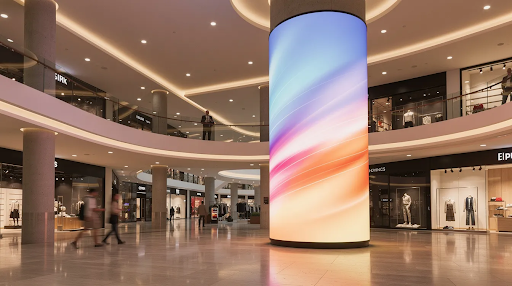
Understanding how flexible LED screens work starts with their modular, bendable electronic design. Instead of traditional rigid PCBs, every layer of a flexible module is engineered for bending and repeated flexing without damage.
The layered structure includes a soft PCB, LED diodes (SMD or GOB), driving ICs, and flexible insulation. Each layer must tolerate bending within specified curvature limits. The minimum bend radius varies by pixel pitch and module size. For example, modules with pitches around P1.25 typically require a minimum bend radius around 150 mm, while larger pitches like P4 can bend more tightly to around 50–120 mm.
Flexible LED modules snap or magnetically adhere onto custom curved metal frames, enabling fast alignment for concave and convex surfaces. Flexible LED displays can conform to non-flat surfaces for creative installations, and this magnetic mounting system means individual modules can be swapped quickly.
Signal and power distribution is critical. Data and power cables are routed behind the curved LED screen, with power supply feeds evenly distributed to avoid voltage drops. Modern control systems handle content mapping across curved geometries so visuals aren’t stretched or distorted. Refresh rates reach 3,840 Hz or higher, making these screens camera-friendly for events and broadcasts.
When correctly installed, flexible LED screens maintain uniform brightness and color accuracy even on tight curves, delivering seamless visuals for creative installations.
Key Features of LED Flex Screens
Below are the key features that distinguish a flexible LED screen from other LED screens and traditional displays.
- Flexibility and shape options: Flexible LED screens can bend, fold, or curve to fit different shapes including cylinders, arches, waves and ribbons. Bend angles up to 140° are available in some product lines, with modules offered in standard sizes like 240×120 mm and 320×160 mm.
- Thin and lightweight construction: Without heavy metal frames, flex modules reduce load on mounting surfaces, making them suitable for ceilings, under-balcony fascia and structures that cannot support heavier rigid panels. Easy installation follows from this reduced weight.
- Modular and custom sizing: Individual modules are interchangeable, allowing designers to create custom dimensions and aspect ratios for any space.
- Visual performance: Flexible LED screens provide wide viewing angles (often exceeding 140°) with sharp colors and high contrast ratios above 5,000:1. High brightness levels and HDR-capable processing make these screens suitable for both indoor and dynamic environments.
- Energy efficiency: Flexible LED technology consumes minimal power while delivering high brightness levels, reducing operating costs over the display’s lifespan.
- Front and rear access: Most flexible LED modules have a front-service design that allows easy maintenance, so failed modules can be replaced without dismantling the entire curved installation.
- Transparency options: Many flexible LED designs offer high transparency, allowing airflow and natural light to pass through, which is valuable for glass façades and stage applications.
- Control and content: Compatible with standard LED controllers supporting synchronous and asynchronous playback, remote monitoring and scheduling. Digital content on flexible LED screens can be updated instantly without physical reprinting.
- Durability: IP54–IP65 ratings for outdoor curved installations, fire-retardant materials for indoor venues, and silicone coatings for added protection make these screens durable in various applications.
Example specifications at a glance:
| Parameter | Indoor Flexible Screen | Outdoor Flexible Screen |
| Pixel pitch | P1.25-P4 | P3-P10+ |
| Brightness | 500–1,200 nits | 4,500–6,500+ nits |
| Typical use | Retail, galleries, corporate settings | Façades, stadiums, billboards |
Key Benefits and Use Cases of Flexible LED Screens
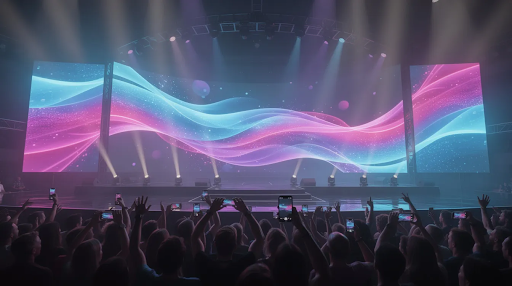
The key benefits of flexible LED displays translate directly into real-world display solutions across retail, corporate, events and architectural lighting.
Design freedom is the primary advantage. Flexible displays can wrap around architectural features, form arches or follow building curves where flat LED displays simply cannot fit. This unparalleled flexibility gives designers the power to integrate display technology into architecture rather than bolting flat screens onto walls.
Space efficiency matters in tight corporate lobbies and corridors. Flexible LED screens hug existing structures, reducing bulky framing and maximising usable floor space.
Audience engagement rises significantly with curved and 360° flexible LED screens. They create immersive experiences that hold attention longer than static posters or flat LCDs. Marketing research frequently cites a 20–50% uplift in dwell time or ad recall for moving, unusual-shape displays compared to static signage.
Commercial impact follows naturally. Flexible LED screens are often used in architectural designs and creative advertising, delivering stronger brand impact and higher event sponsorship value. They enhance retail environments with flowing visual displays and enable dynamic stage backdrops in music venues. Curved LED displays are ideal for exhibitions and trade shows, and flexible LED screens create immersive art installations in galleries and museums.
Concrete use cases include cylindrical flexible LED displays in 2024–2025 retail campaigns across Malaysian malls, wave-shaped concert backdrops for touring acts, and curved information ribbons running through airport terminals as digital signage.
Types of Flexible LED Display Solutions
Flexible LED display products come in several forms tailored to indoor, outdoor, rental and specialty applications. Choosing the right type depends on environment, viewing distance and creative intent.
Indoor flexible LED screens use finer pixel pitch options (P1.25-P2.5) and moderate brightness around 500-1,200 nits nits. Indoor flexible LED displays are ideal for close-up viewing in malls, showrooms, corporate reception areas and galleries. Their lighter weight and thinner profile make them suitable for ceilings and columns.
Outdoor flexible LED screens demand high brightness (4,500 – 6,500 nits+ nits) for visibility in sunlight. Outdoor flexible LED displays are waterproof and durable, with IP65 or higher ratings to handle rain, dust and temperature cycling. Larger pixel pitches (P8-P10+) serve greater viewing distances on building façades, stadium ribbons and curved billboards.
Flexible LED video curtains are lightweight, mesh-like displays that allow air, light and sound to pass through. Transparent LED displays allow light to pass through, making them popular for glass façades and temporary stages where weight and airflow matter.
Specialty formats include cylindrical columns, ring shapes, semi-spherical domes and curved ticker LED screens for arenas and trading floors. Modular LED screens can be assembled into various shapes, and curved flexible LED displays create immersive viewing experiences in entertainment venues and exhibitions.
Curved Installations & Creative Applications
The true strength of flexible LED screens lies in complex curved installations and creative architecture where visual content transforms a space.
Common installation types include concave walls in corporate lobbies, convex edges in auditoriums, 360° circular columns in hotel atriums, ceiling curves and under-balcony fascia LED screens. Each requires careful curvature calculations and frame engineering to maintain visual quality across the entire surface.
Creative applications push boundaries further. Imagine wrapping structural columns in a hotel lobby with slowly shifting ambient visuals-deep blues fading into warm golds, rippling like water. Picture a curved LED art wall in a museum where motion graphics flow across the concave surface, pulling visitors into the piece. In retail, flexible LED screens serve as interactive backdrops where visual presentations of product collections flow seamlessly across curved surfaces.
For staging and events, touring concerts use flexible LED backdrops and side wings that adapt to different stage sizes without redesigning the entire set. The modules detach and reattach via magnets, making setup efficient across multiple venues. This adaptability makes flexible LED screens a preferred choice for innovative visual communication at concerts, trade shows and corporate events.
Planning a Flexible LED Screen Project
Moving from concept to installed flexible LED display requires a structured approach. Here is a practical checklist to guide your planning.
- Define objectives: Decide whether the screen serves branding, information, art or entertainment. Clarify if transparency is needed and whether the installation is permanent or temporary.
- Choose environment: Indoor vs outdoor impacts module selection, IP rating, brightness and structural supports. Flexible LED displays are popular in retail, events, and architectural applications, so match specs to context.
- Determine pixel pitch and viewing distance: P1.25-P2 for viewers closer than 3 metres, P2.5–P4 for 3–6 metres, P5+ for greater distances. Flexible modules can be installed on complex structures or shapes, but pixel pitch must match the intended viewing range.
- Assess structural requirements: Evaluate load-bearing capacity, mounting points, minimum bend radius and access paths for installation teams. Never force modules tighter than their rated curvature.
- Plan content: Curved content mapping requires designers familiar with non-flat LED screens. Visual content must be adjusted for curvature to avoid distortion-orientation, motion paths and aspect ratios all need attention.
- Budget and lifecycle: Factor in hardware, custom frames, control systems, content creation, power consumption and maintenance over a 8 – 10 year year period. LEDs are rated for 70,000 – 100,000 hours under proper conditions.
- Rent before you buy: For Malaysian readers exploring flexible LED concepts at events before committing to a permanent purchase, HeloLED’s LED screen rental Malaysia page offers a range of temporary display solutions.
Why Choose HeloLED for Flexible LED Display Solutions
Helo LED is a specialist in custom curved and flexible LED screen projects across Malaysia and the region. With experience spanning 2019-2026 in flexible and curved LED installations for malls, event venues and corporate spaces, their portfolio demonstrates technical depth in this rapidly evolving display technology.
Their technical strengths include engineering support for unique shapes, in-house design for custom curved frames, and calibration expertise that ensures seamless colour and brightness across non-flat flexible LED video walls. The range of services covers consultation, site survey, design, supply, installation, content integration and after-sales maintenance contracts.
Explore HeloLED’s key resources:
- Flexible LED Screen page for detailed product specs and project inspiration
- Indoor LED Screen Displays page for interior flexible LED solutions
- Outdoor LED Screen Displays page for weatherproof curved installations
- LED Screen Rental Malaysia page for temporary flexible LED screens at events and exhibitions
Ready to explore what a curved LED display can do for your space? Contact HeloLED for a quote, design consultation or site visit for your upcoming project.
FAQ: Flexible LED Screens
Below are answers to common practical questions about flexible LED screens not fully covered above, focusing on lifespan, maintenance, cost and installation specifics.
How long does a flexible LED screen typically last?
Quality flexible LED screens carry a rated LED lifespan of around 70,000 – 100,000 hours, which translates to roughly 8 – 10 years of regular commercial use. Actual longevity depends on brightness settings, ambient temperature, humidity and maintenance frequency. Running screens at lower brightness and ensuring adequate ventilation extends life toward the upper range.
What is the minimum curve radius for a flexible LED display?
Minimum bending radius depends on the specific module model and pixel pitch. Many indoor flexible LED modules with pitches around P1.25–P2 can safely bend to around 120–200 mm radius, while coarser pitches like P4 can achieve tighter curves of 50–120 mm. Always follow the manufacturer’s datasheet to avoid damaging solder joints or LED diodes.
Can flexible LED screens be repaired if individual modules fail?
Yes. Most flexible LED displays are modular, so individual soft modules or LED units can be accessed from the front or rear and replaced without dismantling the entire curved installation. This modular approach keeps maintenance straightforward and minimises downtime.
Are flexible LED screens suitable for 24/7 operation?
Commercial-grade flexible LED screens are designed for continuous operation when supported by adequate ventilation and operated within standard brightness and temperature limits. While the LED modules and power supply units (PSUs) can technically run 24/7, scheduling a daily rest cycle of 8 to 10 hours helps mitigate thermal stress, preventing premature diode degradation and extending component lifespan. Routine cleaning, seal inspections, and power management further ensure consistent long-term performance.
Should I rent or buy a flexible LED screen for my event?
Rental is ideal for short-term events, tours or one-off exhibitions where you want to test shape, content and audience reaction without a large capital commitment. Purchasing makes sense for permanent installations in corporate lobbies, retail spaces or building façades. Malaysian event organisers can compare options on HeloLED’s LED screen rental page before deciding.
YOUR COMMENT