
LED modules have become the standard building blocks for modern lighting and display systems. Whether you are designing a retail sign, an office ceiling grid, or a stadium-sized video wall, understanding how these compact units work will save you time, money, and headaches during installation and long-term operation.
Introduction to LED Modules
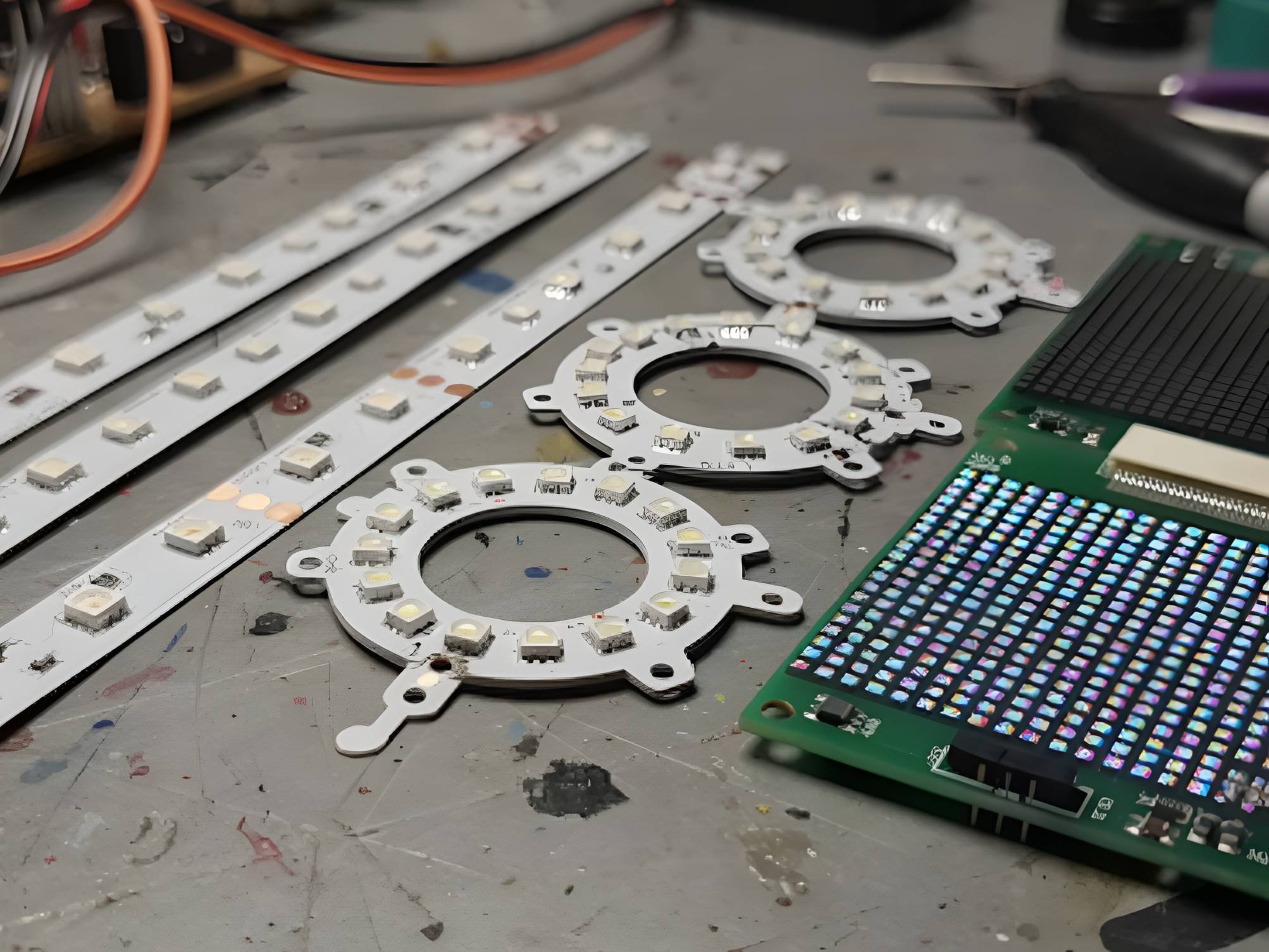
An LED module is a self-contained unit that groups multiple light emitting diodes onto a single PCB alongside connectors, current-limiting electronics, and often secondary optics such as lenses or diffusers. By combining several LEDs on one board, designers achieve target brightness and voltage levels far more efficiently than wiring individual diodes. LED modules simplify the integration of LEDs into larger fixtures, making them standardized, repeatable components.
These modules are used in a variety of applications including architectural lighting and signage, channel letters, emergency luminaires, and full-color LED display cabinets for indoor and outdoor video walls. LED modules come in several types including SMD, COB, flexible, RGB, and high-power variants, each optimized for different requirements. Compared with traditional lighting, modules deliver energy efficiency in the range of 100–200 lm/W, a lifespan typically rated at 50,000–100,000 hours, low maintenance through simple module-level replacement, and flexible form factors from tiny indicator sizes to massive tiled screens.
What Is an LED Module and How Does It Work?
At its core, an LED module is a pre-assembled component combining multiple LEDs, a printed circuit board, connectors, and often secondary optics. The LEDs are arranged in series or parallel strings on the PCB to reach a target voltage and luminous flux. Current flows through each string, regulated by a driver operating in either constant current or constant voltage mode, while thermal management through aluminum substrates or heatsinks prevents junction temperatures from degrading performance.
Concrete examples illustrate the range. A 12 V constant-voltage signage module strip used for channel letters typically contains a few LEDs plus a resistor per segment, designed to be cut to length. A 24 V linear LED module used in office trunking systems chains multiple LED strings in series to match the supply. A P2.5 LED display module used in indoor rental screens packs 128 × 64 RGB pixels into a 320 × 160 mm tile running on 5 V DC. LED modules are often powered by a 5V AC power supply that converts mains to the low-voltage rail the module requires.
Consider a quick numeric example: four LEDs in series, each with a forward voltage of 3.2 V at 700 mA, produce a string voltage of roughly 12.8 V. At 140 lm/W efficacy the module delivers about 1,400 lumens from approximately 10 W of input power. Key parameters to evaluate include lumen output, efficacy, color temperature (3000 K, 4000 K, 6500 K), CRI, and IP rating.
Types of LED Modules (Lighting and Display)
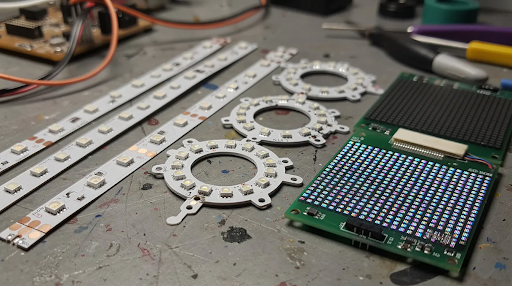
LED modules can be categorized by application and electrical design. On the lighting side, linear LED modules serve office, retail, and architectural projects. Circular or ring modules are designed for downlights and ceiling fixtures. Compact modules target automotive, appliance, and emergency lighting. Common applications of LED modules include downlights, street lighting, and decorative lighting. SMD LED modules are versatile and efficient for general lighting projects, while high-power LED modules deliver intense brightness suitable for outdoor lighting. RGB and tunable white LED modules enable dynamic color control and effects, and flexible LED modules can conform to irregular surfaces for custom lighting effects.
Signage and channel letter modules are commonly 12 V constant-voltage injection-molded units with wide beam lenses, widely used in shopfronts, billboards, and 3D letters. LED display modules tile together to form a larger LED display with full-color RGB capability. Pixel pitch options span from fine-pitch indoor panels (P1.25–P2.5) to coarse outdoor boards (P3.91-P16+). Indoor modules offer higher resolution, lower brightness (600-1,500 nits), and typically non-waterproof SMD packages. Outdoor modules push brightness above 5,000 cd/m², use weatherproof housings, higher IP ratings, and deeper masks for contrast. DIP packaging is suitable for outdoor LED displays, while SMD packaging offers high brightness and reliability for LED modules across both categories.
Constant Current vs. Constant Voltage LED Modules
Every LED module is designed for either constant current or constant voltage operation, and the choice shapes driver selection, wiring, and long-term performance. Constant current LED modules ensure consistent brightness over time because a CC driver keeps the current fixed (e.g., 350 mA or 700 mA) while voltage adjusts to the load. Constant voltage LED modules simplify electrical design and installation by providing a fixed rail-commonly 5 V for display modules, 12 V or 24 V for signage and strips-with on-board resistors or ICs handling current regulation.
| Parameter | Constant Current | Constant Voltage |
|---|---|---|
| Typical voltage | Varies with load | Fixed (5 V, 12 V, 24 V) |
| Wiring complexity | Higher – series strings | Lower – parallel segments |
| Flexibility | Less field-trimmable | Easy cut-to-length |
| Price | Generally higher | Generally lower |
| Best use cases | Museums, hotels, offices | Signage, decorative, DIY |
Select CC modules when uniformity, lifespan, and color stability are crucial-think museums and commercial interiors. Choose CV modules for small decorative runs, retail sign projects, and installations where easy installation and simple wiring matter most. Understanding the trade-offs between these architectures is the first step toward making the right products decision.
LED Display Modules: Pixel Pitch, Size, and Construction
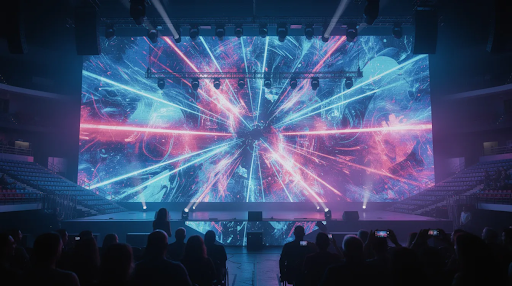
LED display modules are the tiles that assemble into large video screens for stadiums, retail facades, control rooms, and live events. LED modules come in various pixel pitch sizes like P2.5, P5, and P10. Pixel pitch-the center-to-center distance between adjacent pixels-determines the size and resolution of LED modules. HD LED display modules typically range from P1.25 to P2.5 for indoor led screen use, while common outdoor LED module sizes include P5, P6, P8, and P10. A practical rule: pixel pitch in millimeters roughly equals the minimum comfortable viewing distance in meters, so a P2.5 module suits audiences 2.5 m away. Pixel pitch affects viewing distance and image resolution, making it essential to choose pixel pitch based on viewing distance and resolution requirements.
The 320 × 160 mm module has become the dominant standard globally. Other common sizes include 160 × 160 mm, 250 × 250 mm, and 240 × 120 mm. Multiple modules tile into cabinets-outdoor cabinets often measure 960 × 960 mm. Construction includes a PCB with copper tracks and driver ICs, a front black plastic mask for contrast, and an aluminum or plastic rear structure for rigidity and heat dissipation. Connectors provide 5 V power and flat-cable data from receiving cards. LED modules are often packaged using SMD or COB methods. COB packaging provides excellent thermal management for LED displays and enables tighter pixel density. GOB adds a protective epoxy layer for durability in high-traffic or outdoor environments. Select color configuration based on display requirements-RGB for videos and full-color content, or single-color for simple signage. Brightness and contrast affect visibility in different lighting conditions, so always verify nit ratings against your environment. LED modules vary in size based on pixel pitch, and order accordingly.
Installation, Wiring, and Reliability Considerations
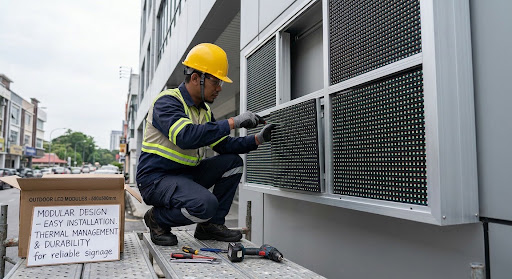
Correct installation and wiring are crucial to achieve uniform brightness, avoid premature failure, and maximize the range of a module’s rated lifespan. For lighting modules, observe proper polarity, size cables for the expected current and distance, and add power injection points on long constant-voltage runs to prevent voltage drop. For LED display modules, distribute 5 V DC from multiple power supplies and route data cables from sending and receiving cards with care for signal integrity.
LED modules can be installed using screws or magnets. Screws into aluminum profiles or cabinets remain the most robust method. Magnetic mounting enables fast service access in rental LED cabinets. Modules can be fixed with special mechanisms for fast extraction in wall-integrated display panels where rear access is impossible.
Durability is crucial for outdoor LED module installations. IP65 or IP67 ratings, conformal coatings, gaskets, and drainage paths protect against moisture and dust. Outdoor LED modules are resistant to moisture and UV when properly sealed, yet real-world failures still occur-lens yellowing and connector corrosion on coastal façade displays installed in 2024 have required periodic module replacement despite IP65 ratings. Thermal management through aluminum substrates and adequate ventilation prevents efficacy loss and color shift. Typical failure modes include LED lumen depreciation, driver failure, and connector corrosion; modular design keeps repairs fast and affordable. Choose reputable suppliers for quality and support to minimize these risks and ensure reliable spare-parts supply.
How to Choose the Right LED Module for Your Project
Selecting the ideal LED module starts with matching your application to a handful of key specifications. First, define the application-signage, general lighting, architectural accent, automotive, or LED display. Next, assess the environment: indoor climate-controlled spaces need only IP20, while fully outdoor sites with UV and moisture exposure demand IP65 or higher. Then confirm the electrical system: what voltage is available (5 V, 12 V, 24 V, 48 V, or mains with an external driver)?
Determine the required brightness. Offices typically target 300–500 lux; indoor LED displays need 600–1,500 nits; sunlit outdoor walls require 4,000–6,000 cd/m² or more. For visual quality, select the appropriate color temperature-warm (2700–3000 K) for hospitality, neutral (3500–4000 K) for offices, cool (5000–6500 K) for industrial spaces. CRI above 90 is ideal for retail and museum lighting; above 80 is adequate elsewhere. For displays, confirm the refresh rate is at least 3,840 Hz for flicker-free videos and broadcast capture, and verify grayscale depth and uniformity across multiple modules.
Finally, prioritize long-term reliability and total cost of ownership over the lowest upfront price. Certified drivers, consistent LED binning, robust thermal design, and a manufacturer warranty of two to five years add cost today but reduce maintenance and replacement expenses over the module’s full vision of service. Take one step at a time: define the application, lock in the environment, then let pixel pitch, brightness, and driver type provide the answers your project needs.
Why choose HeloLED for your future event ?
Experience the difference with HeloLED, where high-performance engineering meets dedicated expertise. Powered by premium LED modules, our fixtures deliver exceptional brightness, flawless color consistency, and long-term energy efficiency designed to lower your operational costs. Backed by a highly responsive technical team that stays continuously attuned to evolving environmental standards, site conditions, and project needs, HeloLED ensures every solution meets the highest standards of safety and sustainability. Call us now to elevate your space with reliable, forward-thinking illumination.
YOUR COMMENT